Discovery
Discovery answers: given what I have saved, liked, disliked, or followed, which papers might I want to add next?
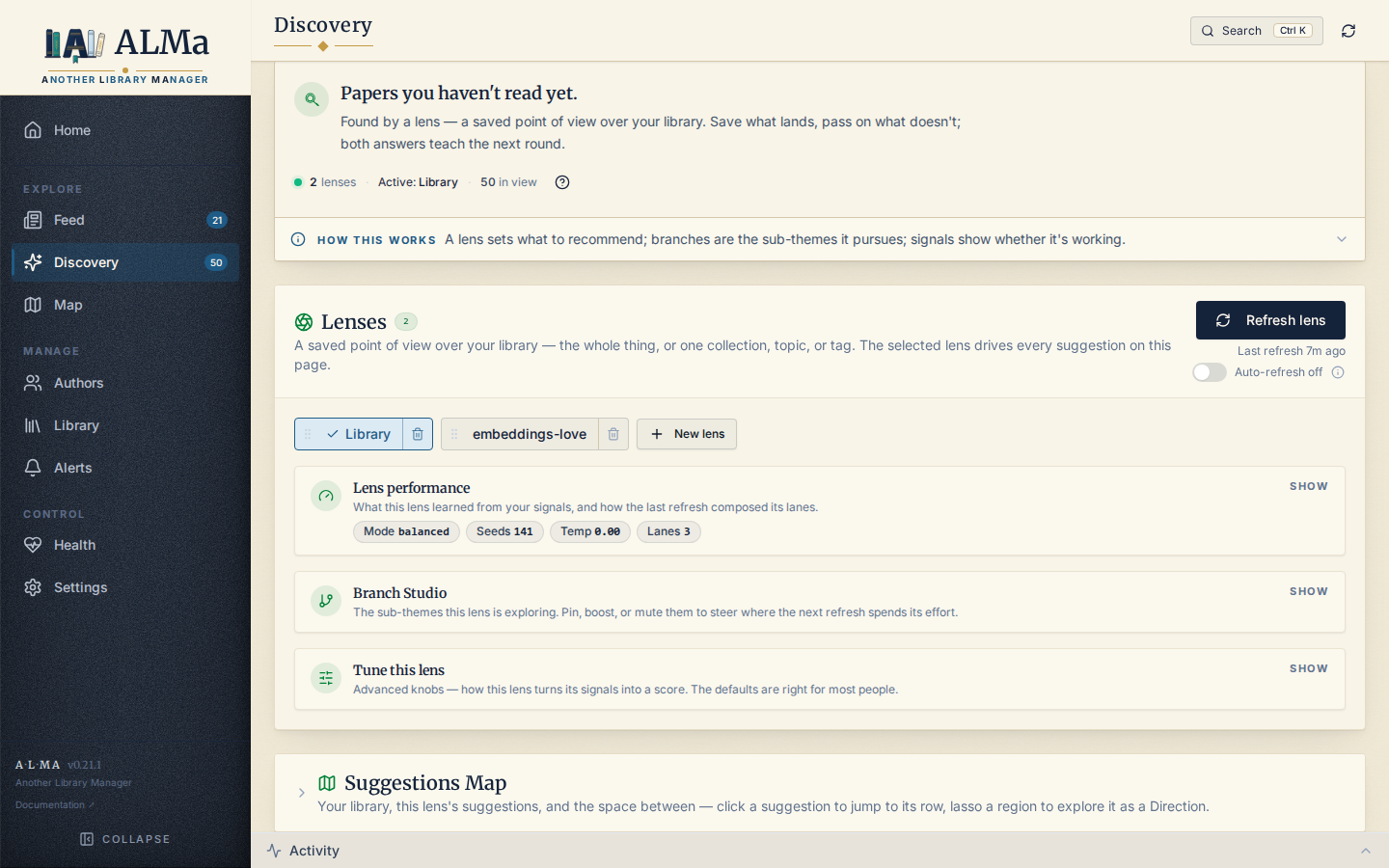
It is explicitly different from Feed:
| Feed | Discovery |
|---|---|
| Deterministic monitoring | Probabilistic recommendation |
| Chronological | Ranked by relevance |
| One source = one row | Multi-source retrieval, deduplicated |
| Window: ~60 days | Window: open |
How a recommendation is produced
Discovery is organised around lenses — context-scoped pipelines. The default "global Library" lens treats your entire saved collection as the seed. You can also define lenses scoped to a collection, a topic keyword, or a tag (see Lenses).
For each lens, refresh runs in four phases:
- Retrieval — fan out across multiple sources to assemble a candidate set.
- Ranking — score each candidate via a 10-weight hybrid formula.
- Diversity-aware staging and filtering — sort by the final score, then run a diversity selector that keeps score-qualified candidates from collapsing onto one source, branch, author, venue, or topic. The staging pool is larger than the visible limit so lifecycle filters can remove saved / dismissed / duplicate papers without starving the final page.
- Branch planning — cluster the lens seed papers into themed branches and use those branches to plan extra external retrieval lanes. Branches are visible in Branch Studio, but not every persisted recommendation currently carries branch attribution.
What leaves Discovery
Several lifecycle filters run before staging, on top of scoring:
- Saved papers (
status='library') — once you save a paper it belongs to your Library and is excluded from Discovery. - Reading-list papers (
reading_status='reading') — adding a recommendation to the Reading list keeps membership orthogonal, but still removes the paper from Discovery because you have acted on it. - Dismissed suggestions (
recommendations.user_action='dismiss', plus legacystatus='dismissed') — explicit dismissals hide the suggestion without changing preference.
Discovery dismissal is scoped to the clicked lens. It uses a slow visibility cooldown; repeat dismissals keep the paper out of that lens longer, but never write a paper rating, feedback event or lens signal. Other lenses remain free to surface the paper. Use Dislike for negative opinion, or Dislike + Dismiss for “bad and gone”.
Like, Love, and Dislike are intentionally softer: they rate the
paper and write feedback signals, but they do not hide the
recommendation or change Library / Reading membership.
Everything else is fair game. Specifically, papers your corpus has
already pulled in but that you haven't saved (status='tracked')
are valid candidates — they may carry an embedding, topics, and
authorship metadata that make them genuinely useful re-suggestions
under a different lens or after enough new feedback shifts the
profile. Tracked papers used to be double-blocked by a permanent
"any prior interaction" filter; that block was removed because it
created a dead funnel as the corpus grew.
Hiding what you've already saved
Discovery already excludes Library papers when it builds a deck (see the lifecycle filters above), but it deliberately keeps a card in place the moment you save it, so nothing vanishes under your cursor mid-triage. Unsaved only in the control bar clears those out — off by default, and the choice persists.
On a collection lens the toggle also overrides that lens's usual exception (it normally still surfaces Library papers filed under other collections so you can pull them in), so "unsaved only" means the same thing on every lens type.
Retrieval families
Retrievers are grouped into four evidence families. A family groups retrievers that fail the same way, which is what lets their ranks be fused fairly — see Discovery pipeline for the full architecture.
| Family | Retrievers | What it knows | How it fails |
|---|---|---|---|
| Lexical | per-topic query over the local corpus + frontier | surface wording | misses paraphrase; rewards common words |
| Semantic | SPECTER2 kNN, one query per branch centroid, over corpus ∪ frontier | meaning | blind without a vector; jargon collisions |
| Citation | local references, bibliographic coupling, co-citation, OpenAlex cites:, S2 related, Personalized PageRank |
who builds on whom | silent on brand-new work |
| Taste | author-id lane, venue lane, followed authors, S2 recommendations, branch queries | your declared interests | echoes what you already know |
Three things about how these query are worth knowing, because each fixed a lane that was retrieving the wrong thing:
- Phrases are quoted. OpenAlex combines adjacent bare words with an implicit
AND, so
working memory OR visual cortexused to parse asworking AND (memory OR visual) AND cortex. Quoting restores the intended union — measurably: the old form's top hit for a vision query was a paper on support vector machines, matched on the loose token "recognition". - Author and venue lanes filter, they don't search. OpenAlex
searchindexes title, abstract and fulltext — not author or venue names. Those lanes now useauthorships.author.idandprimary_location.source.display_name.search. - The dense lane uses one centroid per branch, not one global centroid. The mean of a multi-topic library sits in the empty middle between its topics; a reader working on vision and on methods got the midpoint, which matches neither.
Families can be enabled / disabled / weighted in Settings → Discovery weights. Each lane runs with a per-lane deadline so one slow source cannot stall a refresh.
Every appearance is kept
A lane emits one retrieval hit per (candidate, query) — not per candidate. A paper found by four different topic queries carries four hits, and that cross-query agreement is the strongest precision signal available. The previous merge kept only the winning appearance and discarded the rest.
Where new papers come from
The dense lane used to search only publication_embeddings JOIN papers, so it
could never return a paper the corpus did not already hold — the heaviest
channel contributed zero new papers. It now also searches the frontier: a
bounded citation neighbourhood resolved by a background job, so the network is
off the refresh path entirely. Bibliographic coupling decides what to fetch
using reference edges already in your database, at no API cost.
Best-of-K vs first-N
Every lane ranks before truncating to its budget:
| Lane | Sort order |
|---|---|
| Lexical | local query-match score, fused across per-topic runs by RRF |
| Semantic | cosine to each branch centroid (full pool, never sampled) |
| Graph: local references | corpus_overlap DESC, seed_overlap DESC |
| Graph: OpenAlex related-works | OpenAlex's own relatedness |
| Graph: citing-works | cited_by_count:desc |
| Graph: PPR | personalized-PageRank stationary probability |
| Followed / taste author | publication_date:desc under an author-id filter |
| Taste venue | publication_date:desc under a source filter |
| S2 recommendations | S2's own recommender ranking |
So whatever the per-lane cap is, you get the best of that source — not whatever it happened to return first.
Ranking signals
The hybrid scorer combines (default weights configurable):
- Source relevance — how strong was the signal that produced the candidate (high for related-works, lower for broad topic search).
- Topic score — overlap between the candidate's topics and your preferred topics.
- Text similarity — semantic (SPECTER2 cosine if available) + lexical fallback (TF-IDF + character n-grams + scholarly term overlap).
- Author affinity — has the candidate's author appeared in your
Library or follow list? Affinity weights use log-prevalence
(
log(1 + count) / max_log) for authors, topics, and journals alike, so a single dominant author can't crowd the long tail down to noise. Co-authors that appear on a handful of saved papers still register as "this is someone you've worked with." - Journal affinity — does the candidate's venue appear often in your Library?
- Recency boost — newer papers get a small boost. The boost
reads
yearfirst, then falls back to parsingpublication_dateso corpus-rehydrated papers (wherepublication_datewas filled butyearmay not be) still surface here. This is intentional — Discovery is a place to find recent-but-not-yet-monitored work, complementing what the Feed already shows. - Citation quality — log-scaled citation count.
- Feedback adjustment — boosts or penalises candidates connected to papers you've liked, loved, disliked, or removed. The signal propagates through the paper itself, its authors and co-authors, topics, venue, keywords, and tags.
- Preference affinity — distance from your
preference_profilescentroid.
The ten families the ranker weighs are assembled from these measurements —
semantic and lexical split the text similarity, citation folds in the
citation-fabric strengths below, and retrieval folds in multi-source
agreement. See scoring formulas.
The citation-fabric signals reward candidates that share citation structure with the papers you've saved or loved:
- Coupling — the candidate and a saved/loved paper cite the same works (a shared past / bibliographic coupling).
- Co-citation — some other paper cites the candidate together with a saved/loved paper (a shared reception).
Both are computed once per refresh as batched set intersections over the local
publication_references table (no network, no per-candidate query) and squashed
to [0, 1] by a saturating n / (n + k) curve. They enter the score as
max-combined atoms of the citation family — two views of one citation
neighbourhood, paid once — alongside citation count, field-weighted impact and
personalised-PageRank proximity. The recommendation card shows the evidence as
chips ("Shares N references with
Multi-source agreement rewards candidates independently surfaced by more
than one retrieval family. Each non-external channel (lexical, vector,
graph) counts as one; the external channel counts each distinct source API
separately. The count enters as the retrieval_family_count atom of the
retrieval family, and is also carried in the breakdown as consensus_count /
consensus_buckets so the "found by N sources" chip stays auditable.
Both of these used to be free-standing additive bonuses bolted on after a weighted composite. That composite was discarded by the ranker, so the bonuses moved nothing on Discovery; folding them into the families is what made them count (2026-07-28).
Each candidate's score_breakdown carries explanation — the closed
decomposition of the score, family by family and atom by atom — which is what
the card's Why panel renders.
Outcomes feed back into retrieval, not into the score. Each lens
channel (lexical / vector / graph / external) is scaled at refresh by its
yield — of the papers it helped surface, the share you kept — shrunk toward
the pooled rate by a strength derived from the data, and bounded to
[0.5, 1.5]. Until your history shows the channels differing, every multiplier
is 1.0. The lens's Lens Weights panel states the counts and the weight
actually used. See docs/reference/scoring.md → "Channel yield".
Refresh size and the staged page
POST /lenses/{id}/refresh?limit=50 is the user-visible target —
50 means "50 cards actually land on the Discovery page after every
filter and diversity check." The backend oversamples internally
(per-lane retrieval pulls more than 50 each, scoring runs on the
full pool, then truncation lands 50) so 50 is reliable rather
than aspirational. The frontend LENS_REFRESH_LIMIT constant
controls this number from the UI.
The Discovery page itself opens to the first 20 of the 50 by default with a Show all 50 recommendations button below — keeps initial scroll economical, no second network round-trip on click because the full 50 are already in memory. Switch lenses → resets to the curated 20.
Activity transparency: per-lane subtasks
Every lens refresh emits one parent Activity row + four child
rows, one per retrieval lane (lexical, vector, graph,
external). Each child carries its own status, start/finish time,
duration, candidate count, and failure message. The parent's log
stream carries lane.<name>.start and lane.<name>.completed
markers linking to the child via subtask_job_id, so the Activity
panel can drill from "lens refresh took 11 s" to "graph lane took
5.8 s, vector took 78 ms" with one expand. A failed external
query (e.g. S2 rate-limit) lights up only the offending child red;
the rest still complete green and the parent reports a partial
success rather than a single composite warning.
Subtask IDs follow the pattern <parent_job_id>_lane_<lane_name>
— e.g. lens_refresh_88069a_lane_graph. They go through the same
operation-status table as any other Activity job, so existing
queries (/api/v1/activity?limit=...) surface them.
Branches
Branches are themed clusters of a lens's seed papers. Today they are primarily a retrieval-planning device: Discovery builds branch core/explore queries and spends part of the external-source budget on those queries. Branch-attributed candidates that remain relevant after scoring can survive into the persisted recommendation set, giving the branch outcome data for auto-weighting. A branch has:
- A label derived from discriminative seed-paper topics and representative titles.
- Core and explore topics used to construct branch-specific external searches.
- Representative seed papers.
- Manual control state (
pin,boost,mute) plus anauto_weightwhen enough branch-attributed outcomes exist.
The Branch Studio UI lets you pin / mute / boost a branch. Those
controls affect branch-specific external retrieval budget on the next
lens refresh. Current production branches are not yet the persistent
hierarchical interest tree described in the experimental branched user
model work; branch outcome learning still depends on enough
recommendations being persisted with branch_id.
How branches are built
_build_seed_branches runs at the start of every lens refresh:
- Cluster the seeds. When ≥ 4 of your library papers carry embeddings, K-means clusters them in SPECTER2 space; otherwise a lexical fallback assigns each seed to its most distinctive token (TF-IDF against the rest of the library — not the most common token, which would collapse every paper containing "neural" into one bucket).
- Right-size K. After K-means the system checks pairwise centroid similarity and merges any pair above 0.85. So a coherent library that forced K=6 doesn't end up with five near-duplicate clusters wasting external API budget on overlapping searches; you get fewer-but-distinct branches when the data supports it.
- Per-cluster topics with TF-IDF. Each branch's
core_topicsare extracted with the cluster's tokens scored against all other clusters' tokens. So a token that appears in every cluster (e.g. "neural" in a neuroscience library) is suppressed, leaving the discriminative term as the branch's identity. This is what stops every branch label from looking like "neural / cortex / model". - Explore topics. Each branch carries
explore_topicsfrom a neighbouring cluster — temperature-gated: at low temperature the explore topics come from the nearest cluster (gradient discovery, a small step away from core); at high temperature they come from the farthest cluster (leap discovery, genuinely orthogonal threads). The branch'sdirection_hintsurfaces this so you know why it's pointing where it is. - Branch identity.
branch_idis hashed from the cluster's sorted seed paper IDs, scoped by lens — so labels can drift without breaking the join to stored recommendations. When the seed set shifts even by one paper, the id changes, but…
Lineage: calibration + controls survive seed drift
When K-means reshuffles a single seed (say, you saved 3 papers
since the last refresh), the new cluster's branch_id is
technically different from the previous one. Two mechanisms ensure
your accumulated calibration and pin/mute/boost don't get lost:
- Calibration lineage.
_enrich_branches_with_outcomeschecks pastbranch_ids inrecommendationsfor this lens and inherits the outcome history of any past branch whose seed set overlaps ≥ 70 % with the current cluster's seed set. - Control lineage.
_apply_branch_controlsdoes the same for pin / mute / boost — a branch you muted three days ago stays muted after K-means reshuffles, as long as the new cluster is ≥ 70 % the same papers.
This lineage is best-effort and only has useful outcome data when
previous recommendations carried branch attribution. If a refresh
produces branch-lane candidates but none survive into persisted
recommendations with branch_id, Branch Studio can still show and
control branches, but auto-weighting and branch diagnostics have no
outcome stream to learn from.
The refresh summary includes diversity and final_mix diagnostics:
source-type counts, branch-attributed count, and max author / venue /
topic concentration. Those fields are the operational check that the
page is heterogeneous without dropping relevance too far.
Auto-weighting and the budget allocator
Every branch gets an auto_weight in [0.3, 1.8] derived from
its save / negative-action history (_compute_branch_auto_weight):
- Bayesian-smoothed positive share, prior strength 6.0, so ~6 actions are needed before the weight moves meaningfully.
- Each action is exponentially decayed with a 30-day half-life. The aggregation window is 60 days. Old signal naturally fades; the branch drifts back toward neutral 1.0 as fresh data dominates.
- New branches with no history start at 1.15 (cold-start visibility lift), so they actually get surface area to accumulate signal in their first couple of refreshes.
The auto_weight is the proportional share each active branch gets of the external lane's per-refresh candidate budget — strong branches get more API queries, weak ones get fewer. Pin and boost are floors on top: pinned branches get at least 1.65×, boosted at least 1.3×, regardless of auto_weight.
Two safety floors prevent self-fulfilling weakness:
branches.min_budget_per_branch(default 8) — no active branch drops below 8 candidates from the external lane regardless of auto_weight. A weak branch needs enough volume to ever recover.- Muted branches receive zero budget but stay in the cluster set, so unmuting recovers them instantly.
Auto lifecycle: rotate, then auto-mute
When a branch's auto_weight crosses meaningful thresholds, the system intervenes automatically before the next refresh:
| auto_weight | What happens |
|---|---|
| ≥ 0.65 | Normal. Branch keeps its core_topics, gets its proportional budget. |
| 0.55 < x ≤ 0.65 | Rotated. Branch keeps the same seed set (and its accumulated calibration history), but its core_topics and explore_topics are swapped for the next refresh. The system probes the explore-angle while the core angle has been accumulating dismisses. The label updates to reflect what the branch is actually probing. If the rotation pulls saves, auto_weight rises and the rotation reverses on the refresh after — fully self-correcting. |
| ≤ 0.55 | Auto-muted. Branch's external lane budget drops to zero. The cluster's seeds still influence ranking through their centroid + the author / topic / venue affinities, but the system stops fanning external API queries off it. The user can manually unmute or pin in Branch Studio to override. |
User-set pin and boost take precedence over both rotate and auto-mute — once you've explicitly endorsed a branch, the system defers to you. User-set mute is preserved.
The thresholds (0.65 and 0.55) and the constants underneath
them (PRIOR_STRENGTH = 6.0, HALF_LIFE_DAYS = 30) live in
application/discovery.py near _compute_branch_auto_weight.
They're tuned for "noticeable enough to act on, not so reactive
that one bad day kills a branch."
Actions on a Discovery card
| Action | What it does |
|---|---|
| Save | Transitions to library with the default rating. The current card stays visible; the next lens refresh excludes it. |
| Reading list | Sets reading_status='reading' without saving it to Library. The current card stays visible and shows Queued while the paper is on the reading list — read from the paper itself, so taking it off the list anywhere (Library, Feed, undo) lets you queue it again from Discovery. The next lens refresh excludes it. |
| Like / Love | Sets rating 4 / 5 and writes a positive feedback signal. The recommendation stays visible. |
| Dislike | Sets rating 1 and writes a negative feedback signal. The recommendation stays visible. |
| Dismiss | Hides this lens suggestion only. It changes no rating or preference signal; a per-lens cooldown controls re-entry. |
| Pivot | Treats the paper as a seed for a new branch (find more like this, but I haven't saved it). |
| Open details | Opens the shared Paper detail panel — abstract, topics, prior / derivative works, full provenance. |
Paper feedback is graph-shaped, not just paper-shaped. A 5-star paper raises nearby authors, topics, venues, keywords, tags, close semantic neighbours, and local citation neighbours; a disliked or removed paper lowers those connected signals. Following an author adds a positive author signal to Discovery, and rejecting an author adds a negative ranking signal through that author's profile. Except for explicit Save / Reading-list actions, this changes ranking only. It does not delete papers, unfollow authors, or mutate paper lifecycle state.
The Paper detail panel shows Prior works (papers this one cites) and Derivative works (papers that cite this one). For papers already in our corpus, those panels link directly; for S2 rows we haven't imported, they show a stub with citation intent metadata.
Performance
A canonical lens refresh against ~330 saved papers completes in about 60 seconds end-to-end. Subsequent refreshes against the same lens use cached candidates and are dramatically faster. See Performance for the full budget table and how to profile your own refresh.
A lens refresh now runs in the background job pool: the refresh
POST returns instantly, and an in-page RefreshRunningBanner
shows while the job runs and self-clears when it finishes. You can
keep reading the current cards while the new set is being built.
Find & add — in-page author search
The Find & add panel at the top of the Discovery page also
supports clickable, library-integrated author search. Type
author:<name> and instead of papers the panel renders author
cards — each showing the author's institution and their top-cited
papers, with no ranking bar. Clicking a card opens the same
AuthorDetailPanel popup the Authors page uses (you do not have
to follow the author first). Results are deduped against your local
authors, so a card you already track is marked accordingly
(existing_author_id / already_followed). The cards are backed by
the /library/import/search/authors and
/library/import/search/authors/top-works endpoints.
What Discovery is not
- It is not a search engine. Discovery does not take a free-text
query for its ranked recommendations; those operate over your saved
corpus. To search arbitrary papers, use the global search box or the
Find & add panel embedded at the top of the Discovery page (the
OnlineSearchTab) — title, DOI, OpenAlex URL, orauthor:<name>. - It is not deterministic. Two refreshes of the same lens with the same Library can produce slightly different orderings — the signals shift as you save / dismiss things.
- It is not infallible. Read the score breakdown. If a branch looks wrong, dismiss its core papers — that's the loop that tunes the model.
Read more
- Lenses — per-context pipelines
- Scoring formulas — the weight reference
- Tuning Discovery — practical guide